Monday, February 27, 2012


Lines and Spaces practice...on the cheap

Like my previous post, here are a few more ideas that are great practice activities but that can also be used by non-music substitute teachers.

Why pay $50 for a large floor staff out of a catalog? DON'T! Go to the dollar store and buy a white shower curtain and a roll of black electrical tape. Using a yard stick, mark off the lines for a 5 line music staff with a pencil on the shower curtain. I like to make the spaces between lines large enough for students to put their feet inside the lines. I have tiny adult feet (I wear a 5 and a half), so I always mark it larger than my own feet. I make multiples of this cheap-o floor staff because then I can do a whole class practice activity, or I can make multiple stations around the music room with these big staves.

Are you ready for it? The first of many practice activities you can do with this $2 floor staff is....bah-bah-bah-dah...THE TOSS ACROSS GAME!!!

Here are the directions:
.
•Review the names of the line and space notes on the board before playing this game. A good reminder is that the space notes spell the word, “FACE,” from the bottom to the top. To remember the line notes, a reminder is the sentence, “Every Good Boy Deserves Fudge” (the first letter of each word is the order of the line note names). If you wrote this on the board before the game, erase it before playing the game so they have to use their own brains. (Also, see the Lines and Spaces Rap found in one of my previous blog posts)
•Divide the class into 2 teams.
•One student from  team stands at the base of the staff (but their feet can’t actually touch the white plastic). The teacher names a note (such as "space E" or "line B") and the students both toss a beanbag to try to land in that space or on that line. The student(s) that lands in the correct place earns a point for their team.
•How many points they earn is dependent on how far away/how hard to land on the note they tossed is (see staves below for note names and points). If they totally miss and don’t land on a line or a space, give them one more chance to toss, but if they miss again, they lose their turn.
•If a team member tries to give clues by pointing, talks, or exhibits bad sportsmanship, the other team gets a point automatically. 
•Play until each child gets at least 2 turns to be the tosser so if they miss their first answer they get a second chance. The winning team at the end has the most points.

Another way to play this same game is this: Both students toss the beanbag without the teacher calling a note first. Whichever line or space note it lands on, that child must say the correct name of the note. If they say the correct note name, they earn points for their team. 


 More cheap-o floor staff practice activities to come soon. Have a wonderful week!


Monday, February 20, 2012

I'm BAAAAAACCCKKKK!!!!

First, I apologize profusely for my long absence in posting to this blog. I have been amazed that it continues to get views despite my long absence. Life has been a little crazy as life can sometimes be. Cross country move, finding an apartment, finding a new job, trying to help plan a national conference, and trying to finish a degree...all amongst enjoying playing tourist as well. We now live on Long Island and I teach in Manhattan. So far we've been to the Empire State Building, gone to the MET, seen a Broadway play, gone to FAO Schwartz, Times Square, Central Park...

Time to get blogging again, and substitute lesson plans have been on my mind. Probably because I have been sick often this year adjusting to the crazy schedule for my new job. So I think my next several posts will be games/activities a substitute, even a non music sub can do with classes (or can be used by you as review activities with students.

 Caught in a Spiderweb Board Game
Go to my website to download a PDF of the actual game board seen to the left, as well as all of the cards needed to play the game, a template for dice, and game pieces. If you print them all out on card stock and cut out the spiderweb cards and treble clef cards (copy 2 sided), dice (fold and tape to use), and cut out the game pieces, you can make multiple sets of this game and place each set in a large manilla envelope. I leave several sets so the sub can have small groups of students playing around the room at one time (5 or 6 kids per group max).

This is a simple game. All students roll the die to see who goes first. The first student then rolls and moves that many spaces. If he/she lands on a treble clef space, they must pick up a treble clef card and name the letter of the line or space note shown correctly. If he/she names the note correctly they get to stay on that space. If they get it incorrect, they must move back to their previous spot and the next student gets a turn. If this first student lands on a spiderweb space, then they must pick up a spiderweb card and do as the card says (which may be to move forward or back so many spaces, etc.). It is then the next student's turn. If the student lands on a blank square, they luck out because they just get to stay on that space and the next student gets a turn. The first student to make it to the finish wins the game.

More to come tomorrow...I'm on a one week mid-winter break. Yahoo! Have a great week. I know I will enjoy my time off.

Friday, January 7, 2011

This elementary choral arrangement's for you, Irene!

One of our Kodály summer course students, Irene, requested my arrangement of the folk song, "I Don't Care If the Rain Comes Down," that I mentioned in class last summer. My school's elementary choir performed this song recently, and the students had a lot of input into creating the final performance of the piece. So I thought to myself, "Self, why don't you just post in on your blog for anyone who's interested." So here it is, for everyone's use...but Irene, I dedicate this particular blog post to you, my friend. :-)

I can't claim to be the original creator of this idea, either. My friend and colleague, Audrey, presented this song and it's ostinatos to the choir in our Kodály summer course a few years ago and I liked it, so I borrowed her idea and me and my choir students added onto it to make it our own. So my thanks to Audrey, one of my favorite people in the world.


With elementary choirs I have found, true to the Kodály philosophy, that it is always best for students to internalize the folk song before they attempt reading activities or harmonization in a choral piece. My school choir included 3rd, 4th, and 5th graders and the choir was very transient, as was my school. I wanted to give them reading and part-singing opportunities, but had to be careful in how I presented it in order for them to be successful. We learned this song first by doing the associated folk dance.

Instructions: Students stand in 2 concentric circles facing a partner (one partner on the inside, one partner on the outside).
    1. "I don't care if the rain comes down," Walk on beat clockwise (partners will walk opposite directions)
    2."I'm gonna dance all day." Still walking on beat, snap 3 times low middle high to reflect melodic contour
    3."I don't care if the rain comes down," Walk on beat counterclockwise (partners still opposite direction)
    4. "I'm gonna dance all day." Still walking on beat, snap 3 times high middle low to reflect melodic contour
    5. "Hey, hey, carry me away, I'm gonna dance all day." Should be back to partner...high five high low
     on "hey, hey" One arm swing partner and trade places.       
    6. "Hey, hey, carry me away, I'm gonna dance all day." Repeat last motions and switch back to their  
      original places.
    7. On each repetition of the song, students do the same motion, however they will end up with a new
     partner each time. The 2nd time the song is sung students will pass their original partner and move to the
     next person in the circle beside their partner who will become their partner for the "hey, hey" high 5s and
     arm swings. The 3rd time the song is sung, they will pass the previous partner again and move to the next
    person in the circle and so on. Play the game until partners work their way around the circle and back to
    their original partners.

My choir students thought this game was a hoot. Switching partners proved hard for them because they kept forgetting who their last partner was, so it took some practice. They didn't mind practicing, though, because many laughs and giggles were had by all. We played the game during multiple choir rehearsals to make sure the students had internalized the song.


After the song was learned solidly, we moved on to reading the rhythm and melody of the song with solfa, then we read the rhythm and melody of ostinato 1 and practiced singing it against the song, then we read the melody and rhythm of the ostinato 2 and practiced singing it against the song, and lastly we practiced singing all three parts together, song, ostinato 1, and ostinato 2. Once they were comfortable with all of these things, and only then, did I teach them the orchestration to accompany the song with glockenspiel, alto xylophone, and bass xylophone. Go to my website to download a PDF version of the Orff arrangement I created for this song. Notice that ostinato 1 is the same as the bass xylo part and ostinato 2 is similar to the alto xylo part. I found that this helped the choir's intonation, especially as new parts were added.

Finally, as we neared concert time, the choir helped me to decide the final form for our piece. We decided we wanted a "storm" to be the introduction and coda for the piece which we created with body and unpitched percussion. The storm began quietly with sprinkles, built to heavy rain, and then thunder, and then faded away again as the Orff accompaniment began before the choir entrance. At the end of the song, the Orff accompaniment slowly faded out as the storm began, and then the storm built and faded to end the piece.
    1. Begin with wind sounds created with mouths and rubbing hands together.
    2. Move to  finger snaps and mouth pops added as it starts to sprinkle.
    3. Then to lap patting and feet stomping, and then rainsticks and shakers (each student had one)
    4.  Last add a large drum or rubber trashcan for the occasional thunder before slowly working backward  
    through the previous sounds to end the storm and begin the song.

Once we had the storm down we had to decide the actual form of the song. There are many options for this...unison singing, singing in canon, singing with one ostinato or the other or both, how to transition from one part to another, etc. My choir kids decided on this form: Storm, bass xylo part and ostinato 1 two times as an opening, add melody in to bass xylo and ostinato 1 parts, bass xylo part ostinato 1 and add ostinato 2 teo times through as a transition, sing song with both ostinato parts and full accompanient, storm. This isn't the only option, of course, so adjust to fit your students abilities.

I have found that students love creating their own arrangements of folk songs and appreciate having some say in what they will be singing rather than always performing from composed octavos. I would not do this to the exclusion of singing high quality choral octavos, but especially with a young and inexperienced choir, writing your own arrangements of folk songs is a wonderful way to control the difficulty of a piece so you can adjust to your own students' abilities. Don't be scared to try it. There are many folk songs that are age appropriate and that are easily within the ability of an elementary choir to read melodically and rhythmically. Don't want to use Orff accompaniment in a concert? Then write a piano accompaniment if you must, or even better, sing your arrangement accapella. Over the years I have chosen this route many times and have never been disappointed in the results.

The same can be done with older choirs as well, but of course, you must be careful to choose age appropriate folk songs from which to create your ostinatos and arrangements. Choose a folk song that is perhaps longer or has verses, and one which has a theme that appeals to older students, such as sea chanties, cowboy songs, or a folk song in a foreigh language. Junior high students are capable of pulling ostinatos directly out of a song to create their own arrangements for performance, and in my opinion, may learn more from that experience than from singing from an octavo all of the time. How cool would it be for your students to realize that they are musicians who are capable of not only singing someone else's arrangement or composition, but of creating their own arrangements of songs! I think too often in our classrooms students see music, school music especially, as something they can't do without the help of a teacher. We need to create opportunities in our classes to prove them wrong.

Saturday, November 6, 2010

Turkey Day is coming!

Thanksgiving is coming soon. what are YOU thankful for. I, personally, am thankful that my theory teacher is at a conference and we missed two days of theory class. Ha ha! Just kidding... So here are a few Thanksgiving-oriented activities for your classes.

If anyone knows the origin of this song, please let me know. To be honest, I can't remember from whom or where I learned it.


The next song is obviously based on the tune of Zum Gali Gali. The change in text and the accompanying plate game I learned from my good friend, Dr. Michele Paise who is now a professor at Cumberland University in Tennessee. So all kudos for this one go to her. Thanks, Michele!


Another extension could be the typical Orff idea of using word chains to create a larger rondo form. So small groups of children could create food word chains (Example: Turkey, mashed potatoes, hot biscuits, corn) to perform with body percussion and then with un-pitched percussion as small group compositions. The word chains are short, so they would have to repeat the chain at least 4 times to make it more substantial. So for instance a group could perform the chain twice with words and body percussion sounds, and then twice with only un-pitched percussion playing the rhythm of the word chain. Or they could layer in their words perhaps. One student could say and play corn over and over, then the person playing turkey could join in, then mashed potatoes, then hot biscuits. Let students be creative and come up with unique ways of performing their words chains. Don't insist that every group must do it exactly the same way. In what other subject in school can students be creative and make their own choices? The final performance would alternate singing the song with group 1 performing their word chain, then the song, then group 2 performing their word chain, and so on.

Have a great week!

Wednesday, October 27, 2010

Halloween....oooooooooooooooo!

Sorry it's been a long dry spell from me with the blogging thing. As some of you my or may not know, after many years of teaching full-time and going to grad school part-time, this year I have become a full-time graduate student at Arizona State University to finish my doctorate.  October was my month 'O travel, too. I've been in Minneapolis, Fresno, and Denver in the last month. So, Travel + Grad school = no blogging from me for a while. Sorry about that!!! I promise to post more often when I catch a few minutes between theory homework and philosophical readings. Foucault, Marx, and Green, Oh, my!

I'm back just in time for Halloween, one of my favorite holidays of the year. Why, you ask? Because my birthday is in October and I have fond memories of having Halloween-themed birthday parties as a kid. So here's a few Halloween activities for your classroom this week...or next year, since I'm late. :-) As usual, I'll put the visuals on my meyersmusic.net website linked at the right.

Miss White Had a Fright


I tend to stretch using a song or chant over several classes, but if you prefer not to, you are the queen or king high poobah of your own music class. So, I'm just sharing the steps I take over several lessons below.

Lesson 1: Class echoes the poem by phrases using different silly voices. While they echo a student draws a ghost song on the board. The class then sirens the picture drawn. Add instrument parts such as rhythm sticks play the rhythms of the words throughout, while drums play all of the words that rhyme with "White" and triangles play all of the words that rhyme with "ghost." Practice saying it with the chant, and playing it without saying the words, etc.


Lesson 2: Review the poem. Say the poem with different voices, and as they say it, they make “ghost songs” with their pipe cleaners. At the end of the poem, all sing their ghost songs together. After they’ve had some practice, individual kids can sing their songs for you. (Good assessment of understanding high and low and using the head voice) and they can make "ghost compositions by combining their pipe cleaner shapes with those of other students.

Lesson 3: Kindergarteners find the rhythms with the ghost icons. 1st graders transfer this to tas and ti-tis.


Lesson 4: Students get baggies with the icons or ta ti-ti patterns and they must show you they can put them in the correct order to fit the chant.

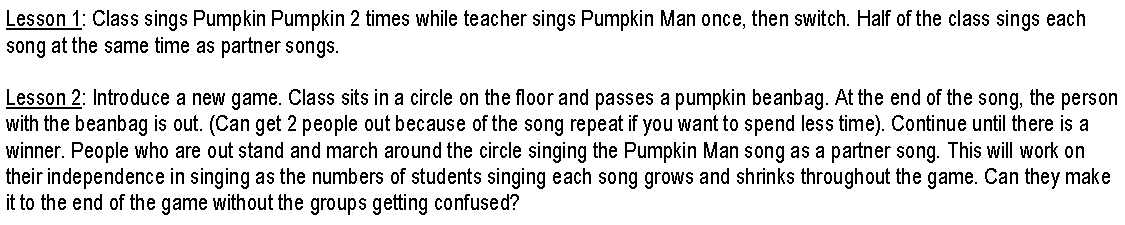
Pumpkin, Pumpkin and Pumpkin Man

OK. Here's something for older students, although you can use the song Pumpkin Pumpkin with younger students, the combination of these two songs is really more appropriate for older students.


If you want another extension on this game, you can have students switch which of the two songs they are singing when the teacher hits a hand drum. Or, have students switch from singing the words of the song to saying the rhythms of the song when the teacher hits a drum...or switch to melodic solfa. Students switch back to words again when the drum is hit again. Very challenging!
 
I hope you try these activities and find them successful. Happy Halloween, everyone! May your students nots come to school next week hopped up on Halloween candy. ;-)
Pumpkin, Pumpkin

Lesson 1: Learn the song and game. Stand in a single circle facing a partner who is beside you. Pat clap pat clap pat clap out on, “Pumpkin, pumpkin, round and fat.” Grab hands and switch places with partner on, “Turn into a jackolantern.” Jump and turn backwards to face a new partner on the word, “that.” Continue the game until you make it back to your first partner.

Lesson 2: Use the song to practice tika-tika rhythms in 2nd grade or older students for review once they know the song well.

Lesson 3: Use the song to practice d m d m d m s (notice, the hand clap movements mirror the melodic contour). Older students can use the song for fa.

Sunday, June 13, 2010

Ah! Summer...

I know it has been a while since I have had a chance to post. Sorry! Here in Arizona the school year has ended and we are a few weeks into summer. Yahoo! In the weeks since my last blog post I have had my end of the year school concerts, entered 650 grades into the computer, gotten strep throat and a sinus infection simultaneously, and packed up my entire classroom and dragged it home and into a storage unit. It's amazing how much teaching "stuff" one accumulates over the years. Now we are heading into the second week of the summer Kodaly levels course here at Arizona State University.

To make up for leaving you high and dry for several weeks, if you follow the link to the right to get to my meyersmusic website, you will be rewarded with a plethora of visuals to peruse in the next few weeks. I am beginning to post visuals and activities we have used in the summer course at ASU with our level I and II students so they have easy access to them and we don't kill a small forest printing everything out for them. Keep checking back in the next week or two because I will continue to add things in as we use them in class and I realize I haven't posted particular items yet. I'm not going to bother with directions here on the blog because I attached directions to each set of these visuals on the website already.

For those of you already on summer vacation, I hope it is wonderful and relaxing. For those of you still in school, may the coming weeks fly by and the joys of summer find you quickly. Take care!

Sunday, April 11, 2010

A musical challenge, tap your head and rub your belly...

OK, so most of you have probably seen a version of this activity if you have taught in a Kodaly-inspired general music class for any length of time. Still I am always amazed when I present clinics that there are teachers who have never seen activities that I thought were old standards, or that I somehow have put a Liza-esque twist on it that they have never seen. Or perhaps if you have done this activity exactly as I have written it, you will at least enjoy the fancy-schmantz visuals I have included for your use. :-)


Beat/Rhythm Puppets: Students pat the beat or clap the rhythm of a known song following the sign that the teacher shows (or you could have a student leader). Change in easier places, like the ends of a line or phrase with younger students. Change in more difficult places, like in the middle of a line or phrase, or switch more quickly back and forth for older students.

Sing/Think (Inner Hear) Puppets: Students follow the signs to either sing a song phrase out loud, or put it inside their heads and think the words. When the sing sign is shown again, the class must come in singing at the correct spot in the song. Change difficulty based on age and ability as suggested above.

Combining the Beat/Rhythm and Sing/Think Puppets: For an added level of difficulty put the Beat/Rhythm on one hand and the Sing/Think on the other hand. Students must then follow both plates at the same time no matter what combination is showing. For instance, they may have to sing and pat the beat, sing and clap the rhythm, inner hear and pat the beat, inner hear and clap the rhythm, etc.


Words and Solfa(do re mi)/Rhythm Syllables (ta ti-ti) Puppet: With younger students you may want to perform the two cards seperately so that they switch between the words of a known song and the rhythm perhaps on one day. On another day you may have them switch between the words of a known song and the solfa syllables.

After practicing these seperately as you do with the younger students, older students should be capable of doing all 3, switching between the words and either the solfa or rhythm syllables. To do this, you may want to create a seperate set of puppets so that one hand holds a sign that ONLY says words, and the other hand has a sign that has the rhythm syllables on one side and the solfa on the other side. This will save your sanity. But if you want to, you can use the puppets as is, you just have to remember which hand is showing which direction and only show one hand at a time.


EXTREME MUSIC CHALLENGE: To really mess with their minds, combine all of the puppets above for interesting combinations like pat the beat and say the melodic solfa, or clap the rhythm and say the rhythmic solfa, etc. I have done it with adults and children, and it is possible, but you have to think it though.

I usually pick two very smart students to help me challenge the class by being the holders of the puppets. Have student A hold the beat/rhythm puppet on one hand and the sing/think puppet on the other hand. Have student B hold the words puppet on one hand and the rhythm (ta ti-ti)/solfa (do re mi) puppet on the other hand. Then I instruct these students that I will be controlling which hand they are to turn and when by tapping them on the shoulder when I want them to flip the sign that they have in that hand. (student B must also know to put down the words sign when using the rhythm/solfa and vice versa). I then stand behind these two students in order to tap their shoulders more easily. When using all of the cards, you REALLY need to choose a song they know very well, and you need to choose a song that is long or has multiple verses. I have used it with Rocky Mountain, which has 3 verses plus the chorus each time, and it worked out.

That's about as clear as mud, I know. It's so much easier to demonstrate this than to try to clearly put it into words! Experiement on your own and you will find out what works for you. Don't forget to start easier even with older students who haven't done this before and work your way up to the harder challenges. Too many times teachers try an activity, it bombs, and they never do it again because they think it won't work, when in reality the teacher hasn't gone through all of the necessary steps and practice for their students to be successful with a difficult activity. When I find something not working in a lesson, I almost always realize it's my fault one way or another. Instead of scrapping the activity, I go back and find out what I need to do to better prepare the students to succeed.

My kids love challenges and are thrilled when they can pull of something tricky. I hope yours will enjoy these activities, too. Go to the meyersmusic.net website to download a PDF with all of the visuals for this activity. All you need to do is print each page out on cardstock, cut each pace in half and staple the two halves together all around the top and two sides of the paper. Leave the bottom of the paper unstapled because you can then stick your hand into the "puppet."