Wednesday, October 27, 2010

Halloween....oooooooooooooooo!

Sorry it's been a long dry spell from me with the blogging thing. As some of you my or may not know, after many years of teaching full-time and going to grad school part-time, this year I have become a full-time graduate student at Arizona State University to finish my doctorate.  October was my month 'O travel, too. I've been in Minneapolis, Fresno, and Denver in the last month. So, Travel + Grad school = no blogging from me for a while. Sorry about that!!! I promise to post more often when I catch a few minutes between theory homework and philosophical readings. Foucault, Marx, and Green, Oh, my!

I'm back just in time for Halloween, one of my favorite holidays of the year. Why, you ask? Because my birthday is in October and I have fond memories of having Halloween-themed birthday parties as a kid. So here's a few Halloween activities for your classroom this week...or next year, since I'm late. :-) As usual, I'll put the visuals on my meyersmusic.net website linked at the right.

Miss White Had a Fright


I tend to stretch using a song or chant over several classes, but if you prefer not to, you are the queen or king high poobah of your own music class. So, I'm just sharing the steps I take over several lessons below.

Lesson 1: Class echoes the poem by phrases using different silly voices. While they echo a student draws a ghost song on the board. The class then sirens the picture drawn. Add instrument parts such as rhythm sticks play the rhythms of the words throughout, while drums play all of the words that rhyme with "White" and triangles play all of the words that rhyme with "ghost." Practice saying it with the chant, and playing it without saying the words, etc.


Lesson 2: Review the poem. Say the poem with different voices, and as they say it, they make “ghost songs” with their pipe cleaners. At the end of the poem, all sing their ghost songs together. After they’ve had some practice, individual kids can sing their songs for you. (Good assessment of understanding high and low and using the head voice) and they can make "ghost compositions by combining their pipe cleaner shapes with those of other students.

Lesson 3: Kindergarteners find the rhythms with the ghost icons. 1st graders transfer this to tas and ti-tis.


Lesson 4: Students get baggies with the icons or ta ti-ti patterns and they must show you they can put them in the correct order to fit the chant.

Pumpkin, Pumpkin and Pumpkin Man

OK. Here's something for older students, although you can use the song Pumpkin Pumpkin with younger students, the combination of these two songs is really more appropriate for older students.


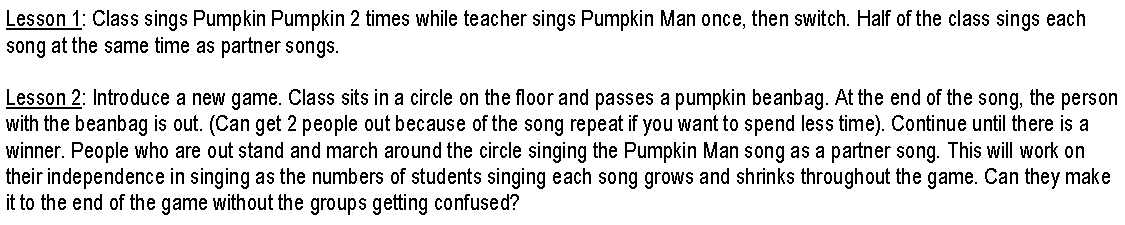
If you want another extension on this game, you can have students switch which of the two songs they are singing when the teacher hits a hand drum. Or, have students switch from singing the words of the song to saying the rhythms of the song when the teacher hits a drum...or switch to melodic solfa. Students switch back to words again when the drum is hit again. Very challenging!
 
I hope you try these activities and find them successful. Happy Halloween, everyone! May your students nots come to school next week hopped up on Halloween candy. ;-)
Pumpkin, Pumpkin

Lesson 1: Learn the song and game. Stand in a single circle facing a partner who is beside you. Pat clap pat clap pat clap out on, “Pumpkin, pumpkin, round and fat.” Grab hands and switch places with partner on, “Turn into a jackolantern.” Jump and turn backwards to face a new partner on the word, “that.” Continue the game until you make it back to your first partner.

Lesson 2: Use the song to practice tika-tika rhythms in 2nd grade or older students for review once they know the song well.

Lesson 3: Use the song to practice d m d m d m s (notice, the hand clap movements mirror the melodic contour). Older students can use the song for fa.

Sunday, June 13, 2010

Ah! Summer...

I know it has been a while since I have had a chance to post. Sorry! Here in Arizona the school year has ended and we are a few weeks into summer. Yahoo! In the weeks since my last blog post I have had my end of the year school concerts, entered 650 grades into the computer, gotten strep throat and a sinus infection simultaneously, and packed up my entire classroom and dragged it home and into a storage unit. It's amazing how much teaching "stuff" one accumulates over the years. Now we are heading into the second week of the summer Kodaly levels course here at Arizona State University.

To make up for leaving you high and dry for several weeks, if you follow the link to the right to get to my meyersmusic website, you will be rewarded with a plethora of visuals to peruse in the next few weeks. I am beginning to post visuals and activities we have used in the summer course at ASU with our level I and II students so they have easy access to them and we don't kill a small forest printing everything out for them. Keep checking back in the next week or two because I will continue to add things in as we use them in class and I realize I haven't posted particular items yet. I'm not going to bother with directions here on the blog because I attached directions to each set of these visuals on the website already.

For those of you already on summer vacation, I hope it is wonderful and relaxing. For those of you still in school, may the coming weeks fly by and the joys of summer find you quickly. Take care!

Sunday, April 11, 2010

A musical challenge, tap your head and rub your belly...

OK, so most of you have probably seen a version of this activity if you have taught in a Kodaly-inspired general music class for any length of time. Still I am always amazed when I present clinics that there are teachers who have never seen activities that I thought were old standards, or that I somehow have put a Liza-esque twist on it that they have never seen. Or perhaps if you have done this activity exactly as I have written it, you will at least enjoy the fancy-schmantz visuals I have included for your use. :-)


Beat/Rhythm Puppets: Students pat the beat or clap the rhythm of a known song following the sign that the teacher shows (or you could have a student leader). Change in easier places, like the ends of a line or phrase with younger students. Change in more difficult places, like in the middle of a line or phrase, or switch more quickly back and forth for older students.

Sing/Think (Inner Hear) Puppets: Students follow the signs to either sing a song phrase out loud, or put it inside their heads and think the words. When the sing sign is shown again, the class must come in singing at the correct spot in the song. Change difficulty based on age and ability as suggested above.

Combining the Beat/Rhythm and Sing/Think Puppets: For an added level of difficulty put the Beat/Rhythm on one hand and the Sing/Think on the other hand. Students must then follow both plates at the same time no matter what combination is showing. For instance, they may have to sing and pat the beat, sing and clap the rhythm, inner hear and pat the beat, inner hear and clap the rhythm, etc.


Words and Solfa(do re mi)/Rhythm Syllables (ta ti-ti) Puppet: With younger students you may want to perform the two cards seperately so that they switch between the words of a known song and the rhythm perhaps on one day. On another day you may have them switch between the words of a known song and the solfa syllables.

After practicing these seperately as you do with the younger students, older students should be capable of doing all 3, switching between the words and either the solfa or rhythm syllables. To do this, you may want to create a seperate set of puppets so that one hand holds a sign that ONLY says words, and the other hand has a sign that has the rhythm syllables on one side and the solfa on the other side. This will save your sanity. But if you want to, you can use the puppets as is, you just have to remember which hand is showing which direction and only show one hand at a time.


EXTREME MUSIC CHALLENGE: To really mess with their minds, combine all of the puppets above for interesting combinations like pat the beat and say the melodic solfa, or clap the rhythm and say the rhythmic solfa, etc. I have done it with adults and children, and it is possible, but you have to think it though.

I usually pick two very smart students to help me challenge the class by being the holders of the puppets. Have student A hold the beat/rhythm puppet on one hand and the sing/think puppet on the other hand. Have student B hold the words puppet on one hand and the rhythm (ta ti-ti)/solfa (do re mi) puppet on the other hand. Then I instruct these students that I will be controlling which hand they are to turn and when by tapping them on the shoulder when I want them to flip the sign that they have in that hand. (student B must also know to put down the words sign when using the rhythm/solfa and vice versa). I then stand behind these two students in order to tap their shoulders more easily. When using all of the cards, you REALLY need to choose a song they know very well, and you need to choose a song that is long or has multiple verses. I have used it with Rocky Mountain, which has 3 verses plus the chorus each time, and it worked out.

That's about as clear as mud, I know. It's so much easier to demonstrate this than to try to clearly put it into words! Experiement on your own and you will find out what works for you. Don't forget to start easier even with older students who haven't done this before and work your way up to the harder challenges. Too many times teachers try an activity, it bombs, and they never do it again because they think it won't work, when in reality the teacher hasn't gone through all of the necessary steps and practice for their students to be successful with a difficult activity. When I find something not working in a lesson, I almost always realize it's my fault one way or another. Instead of scrapping the activity, I go back and find out what I need to do to better prepare the students to succeed.

My kids love challenges and are thrilled when they can pull of something tricky. I hope yours will enjoy these activities, too. Go to the meyersmusic.net website to download a PDF with all of the visuals for this activity. All you need to do is print each page out on cardstock, cut each pace in half and staple the two halves together all around the top and two sides of the paper. Leave the bottom of the paper unstapled because you can then stick your hand into the "puppet."

Sunday, April 4, 2010

See the Rabbit Running...

Ok. So I figured you might want a bunny song appropriate for older kids, so here goes...My older students love the game that goes with the song, "See the Rabbit Running." Pedagogically I use this song  for low la since it only appears one time at the very end of the song.

Have the students stand in a circle and hold hands. One child (rabbit) stands in the middle. Another child (fox) stands on the outside. As the song is sung the “trees,” or students in the circle, decide if they will open or close their branches at the end of the song. At the end of the song the fox chases the rabbit. They may go around the circle when chasing, or they may cut through the middle of the circle as long as they only duck under arms that are raised. Remind the students in the circle that once the song is over and they choose to put their arms either up or down, they may not change their arms until the reace is over. This will prevent a student from getting clothes-lined by accident. The fox takes over as the rabbit if he catches the rabbit. The rabbit takes over as the fox if he doesn’t get caught. I usually give a 10 second countdown for the chase and no more. The rabbit is considered safe if not caught by the end of this time. After the students know the song well enough to sing the song well independently of the teacher, then the song can be used for low la.

I have a small-ish music room, but all of my furniture is against walls, so we are able to play this chase game without too many problems. If you have no movement space, consider taking your class out into the beautiful spring weather to play the game. Or, I have seen a similar song/game in which the game involved the fox and rabbit having to weave in and out of the windows without skipping any of the windows, and the first one back to their original spot in the circle wins the round of the game. This might be a good alternative if you have little room. Have fun!


Saturday, April 3, 2010

Hop, hop, hop...

Spring is here and the weather in Arizona is gorgeous! For those of you that can use holiday-oriented song material in your schools, I thought you might enjoy this song and related activities for your classroom.


Despite this song having the descending sfmrd pattern, the lyrics are obviously most appropriate for younger grades. I use this song with kindergarteners for melodic contour (the first 2 and last 2 measures of the song) and for beat and rhythm with both movement and with icons. In first grade the song can be used for ta, ti-ti, rest rhythms.

To help the students learn the song, I created a few different activities. Students can play a hide and seek game using those brightly colored plastic Easter eggs that can be found at the dollar store on the cheap. Have all students hide their eyes and sing the song (the teacher can sing the first several times until the kids learn the song), and the teacher hides 4 or 5 eggs in the room. When the song is over, have all students open their eyes and search the room for the hidden eggs. The students who find the hidden eggs then get to hide the eggs before the next round of the game. I know this seems like an amazingly simple game, but the kids really love finding hiding places for the eggs.

On another day, have students hop on the beat, but on the rests they wiggle their bunny ears (fingers at head) to show where the rests are. You can also have them practice hopping the rhythm of the words rather than the beat if you would like. You can use the bunny and egg icons to show the rhythm of the song. (ta=single bunny, ti-ti=double bunnies, rest=egg) Go to my meyersmusic website linked at the right to download these icons.

I often pair this song at a later time with first grades with color word chains. Give partners of small groups of students Easter eggs and tell them they must decide the color of eggs the Easter bunny will leave, but that they can only choose 4 colors. Have them put the eggs on the floor in a line in the order they want the words to appear. Have the class sing the song and then have 3 or 4 groups say and clap their color word chain. Have each group figure out what the rhythm of their words would be. For example, red, yellow, purple, blue would be ta, ti-ti,  ti-ti, ta. Pick a color word chain to use as an ostinato against the song.

If older students learned this song when they were younger and you have had them in music for several years, you can bring this song back for fa ascending and descending in 4th and 5th grade. Then you can extend the color word chain activity into a rondo activity would be good for the older students.

Happy Easter, everyone! Now hand me my chocolate bunny. Yum!


Saturday, March 6, 2010

Sight-reading made fast and easy...

Hi, everyone. As we approach spring break (here in Arizona, at least, where the weather is already quite spring-like) life has gotten busy. So, since I missed posting last week, I'm going to do two entries this week to make up for it. Visuals have been on my mind this week because I just had a Promethean board installed in my music room on Tuesday, which excites me more than you know. I'm just beginning to learn how to use the thing, but can envision how much easier it will be to keep visuals and manipulatives visually on a laptop. Yahoo. Too bad we got the boards about 2 months before the end of the school year.

My 4th graders are moving right along learning how to play their recorders, but every year I get frustrated by the students who simply memorize the songs instead of truly learning how to read the notes. If we practice the song enough times in class, they can memorize the sound of the song and the matching fingerings for that song, but are at a complete loss when a new song appears in front of them. So, every year I think about new ideas or new ways to get them to practice sight-reading. This year I have been using a set of recorder sight reading cards that I can adjust for difficulty and tone set by using velcro (or in my case, now, by using the Promethean board). Maybe this idea will be helpful to you as well.

♫ Go to the meyersmusic.net website linked at the right of this block and download my sight reading card templates. I wanted a short sight-reading time to begin almost every music class, but don't want it to take up very music class time, so I only chose to make 12 rhythm cards. As you can see, you can print out the rhythm pages on card stock and then cut the rhythm cards in half (2 cards per page). Then print out the letter name pages and cut the individual letters apart.

♫ Buy some stick on velcro, or the stick on velcro dots. On the rhythm cards put a piece of velcro underneath every note of the rhythm card (use the rough part of the velcro). On every letter name card put a piece of velcro (use the soft part of the velcro).

♫ When beginning with students, place only one letter name at the beginning of each card, so if the first card says B, they will play the entire rhythm card on the note B. Give them some think time between each card to determine the correct note and fingering before the class plays. Each time they come to class and they read through these cards, swap around which note is played for which card so they can’t simply memorize the cards like many of them try to memorize the songs.


♫ If they get very good at doing this simpler sight-reading activity, then challenge them by having one rhythm card using 2 different pitches on it, then 3, then 4. You can make use of whatever tone set they happen to be working on, so start with BAG at first, and add in other new notes as they progress. You can always add in more difficult rhythm patterns as well if these become too familiar for them.

♫ If you have access to it, I make all of my rhythmic things for visuals using Finale. The newer versions of Finale have a graphics tool that allows you to create music, click on the graphics tool, put a box around the music you want to save, and then it lets you save it as a tiff picture file. I am then able to take these tiffs of individual rhythmic notes, rhythmic patterns, songs, etc., and put them into Publisher to make worksheets and visuals easily.

Try the sight-reading with your students and let me know how it goes. If you discover anything that makes it work better in your classes, or you have any great additions, let me know! Have a great weekend. Spring break, here we come!

♫ Using the velcro letters means that you can use whatever tone set they currently are working on (BAG, BAGED, BAG C’D’) and you can increase or decrease the difficulty as needed.

Sunday, February 14, 2010

Heartbeat cards and rhythms..not just for Valentine's Day.

I happened to think of posting these visuals because it's Valentine's Day. Heartbeat cards. You know. But, unlike the last lesson idea, the heartbeat cards and the rhythms that go with them can be used throughout the school year and with any grade from first up, so I thought you might find them handy. Putting them together yourself can be a bit of a pain, so I saved you the time and effort and just gave them to you already formatted.

Take note...If you use cardstock of whatever colors you choose, you can print the whole rhythm pack out on your computer on cardstock, or if your school's Xerox machine allows for cardstock you can print multiple pages out there, which saves your in in your home printer. When cutting the heartbeat cards apart, just cut the page of cardstock down the center lengthwise so there is a line of 4 hearts on each of the 2 resulting cards. When cutting the rhythm cards apart, be careful!!! The idea is that each rhythm card will take up the same amount of beats/hearts as the note requires. So a ta quarter note is the width of one of the hearts, the syncopah is the width of two hearts, the dotted half is the width of three hearts, and so on. I think you catch my drift. The easiest way to do this is to carefully cut them apart using one of those big choppers they tend to have in schools. I have no idea what they are technically called.

The heartbeat cards and rhythm cards can be used many different ways. Students each have their own 4 beat heart card and the necessary rhythm cards you will be using depending on their grade level and what you have covered in music class, or for younger grades, you could have partners work together.

1. One way I use these manipulatives are to have students figure out the rhythms of a song they already know well. Students will have to figure out how many beats the song is and how many phrases total. (As an example: Snail Snail is 8 beats long and two phrases). As we sing and clap the song, they place the cards they think match the rhythms of the song underneath the heartbeat card (first phrase right under the hearts, next phrase under the first phrase, etc.) Make sure you have them check their answers by singing and touching the rhythms to check for correctness. Younger students will take longer to do this, of course, or older students who are figuring out a longer and more difficult song will need more repetitions of the song to complete their answers. When finished, have the whole class say the rhythm solfa together to check their answers.

2. These visuals can also be used for rhythm dictation in which the teacher claps a 4 beat rhythm and the students "write" it with the cards.

3. They can be used as a means of composing with rhythms, with students creating their own 4 beat rhythm patterns. They can either create multiple patterns to make their own song, or they can combine their rhythm with that of other classmates to create a longer song. Have students perform their rhythm compositions with unpitched percussion, or later add melody to create a complete song.

4. They can also be used to teach older students about meter. My students have found them a great visual reminder of the difference in meters. The heartbeat cards I have given you are for 4/4 meter. You can create other heartbeat cards for other meters, such as a strip of 3 hearts to show 3/4 meter, or 2 hearts to show 2/4 or 6/8 meter. If you stick with duple meters like 4/4, 3/4, or 2/4, the rhythms I gave you will work. Obviously, if you decide to branch our into triple meters, like 6/8 or 9/8, you will have to create some new rhythm cards that fit with triple meter rhythms.

I usually put together sets of heartbeat cards and rhythms in gallon size bags. I adjust what rhythms are in the bags based on the grade that will use them. I hope you find this as useful as I do. To download the heartbeat cards and rhythm pages you can print out on cardstock and cut out, please go to the meyersmusic.net website linked on the right. Hope you all had a wonderful Valentine's Day!